Sunday, 9 September 2012

Pork, Apple & Sage Pie

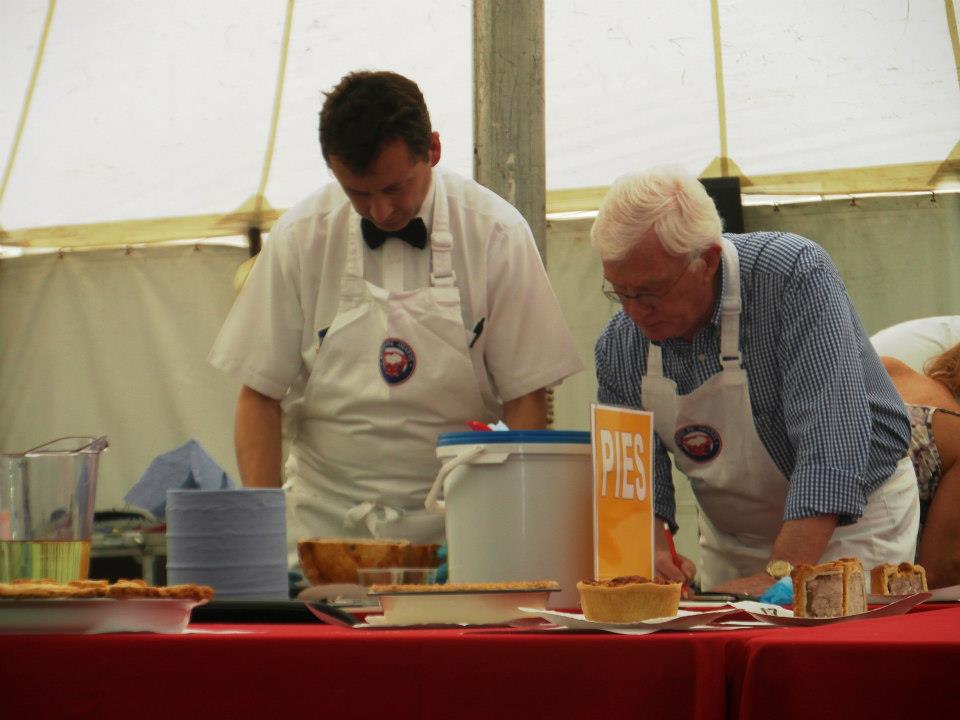
A Facebook Friend of mine entered the cakes vs pies competition for CarFest South and was really excited about it all. It got me interested in it and when she did very well in the cake competition and I saw all the pictures of the event, I could understand her enthusiasm. So when CarFest North announced that they needed pie makers for the event at Cholmondeley, I didn’t hesitate a moment and send an e-mail that I could make pies. I didn’t really expect to hear anything of it, but got a phonecall and was asked what pie? Uhhmmmm, I hadn’t really thought about this, so blurred out: pork, apple & sage pie! Sounds good, was the reply….you are in! And so a week of pork pie making started…….and this came out as the recipe that worked best. To make a 20cm diameter pie you need For the filling 450 gr (1 lb) of pork shoulder meat, diced ½ medium onion, roughly chopped 1 large eating apple, diced A handful of fresh sage leaves, roughly chopped Freshly grated nutmeg Freshly ground black pepper Salt (to taste) 50 ml (still) cider A tub of good quality chicken stock For the pastry 125 gr lard 150 ml water 450 gr (1 lb) of plain flour Salt (to taste) Heaped teaspoon of dried sage 1 egg, beaten
1. First make the pastry by bringing the water and lard to the boil. In the food processor mix together the flour, salt & sage and while the food processor is turning add the hot water/lard mixture. Turn out onto a lightly floured surface. 2. Generously butter a 20 cm (8 inch) loose bottomed tin. 3. Roll out approx 2/3 of the pastry mixture and place into the tin, pressing down well. 4. Cover with cling film and place in the fridge for 20-30 minutes to set 5. Keep the rest of the pastry in cling film in a warm place. Preheat the oven to Fan 180C/Gasmark 5 6. Mince the pork shoulder meat in a food processor and add the onion, apple, sage, nutmeg and seasoning and mix together well. Add the cider and give it another little whisk. 7. Fill you pastry case with the meat mixture nice and full but make sure you don’t overfill it or the pastry case will burst. 8. Roll out the remainder of the pastry and top the pie with this, crimping the edges together. Make a little hole in the middle of the pie top. 9. Whisk the egg loose in a bowl and brush the top of the pastry with this. 10. Place in the oven for 40 – 45 minutes 11. Remove from the oven, leave to stand for a few minutes before removing it from the tin and placing it on an oven tray (take your time over this, as it is a delicate procedure) 12. Brush the sides of the pie with the rest of the egg wash and place back in the oven for another 20 – 30 minutes. After cooking, let the pie cool completely on a wire rack and then in the fridge. Warm up the stock and carefully, using a small funnel, spoon the stock into the pie through the hole that was made in the pastry. Keep spooning it in until the pie will take no more liquid and put it back it the fridge to set. My pie ended just outside of the top ten with a score of 79/100 which for a first attempt I am quite happy with. Some of the comments of the judges were: "pastry should be richer" and "more fat in filling" - I have to say even though I used pork shoulder, I actually removed quite a bit of the fat, next time I know not to!! It was a great fun day and I would do it all again, maybe I should try a cake next time.
The judges looking at my entry

Sunday, 5 August 2012

Grandma Singleton's Lancashire Cheese

I absolutely love cheese! So when Grandma Singleton’s ran a competition on Twitter whereby you could win some cheese, I did not hesitate for one moment. I could not believe my luck when they announced that I was the winner and two days later a lovely hamper with 6 different cheeses, some plum & apple chutney & crackers was delivered. Now cheese & crackers with some nice chutney is a classic of course, but with such a wonderful variety of cheese I decided to make a few dishes and try them out. I choose to make some cheese scones, a quiche and leek & brioche gratin. Next was to determine which cheese would be best suitable for each dish. For this I had to try them all (a tough job, I know, but someone has to do it). My final choices for the dishes were Grandma Singleton’s Parlick Fell Pure Sheep’s Cheese for the scones, the traditional creamy Lancashire for the quiche and Grandma Singleton’s famously strong Lancashire for the leek & brioche gratin.
Grandma Singleton’s Parlick Fell Pure Sheep’s Cheese Scones

Ingredients
350 gr plain flour
1 heaped table spoon baking powder
A good pinch of sea salt
70 gr unsalted butter
100 gr Grandma Singleton’s Parlick Fell Pure Sheep’s Cheese
100 ml milk
2 eggs, beaten

Preparation

Preheat the oven to fan 180C/375F
Mix the flour, salt & baking powder.
Add the butter and rub in.
Add ¾ of the cheese together with the milk and most of the egg (keep about ¼ of this to glaze the scones later). Combine to make a dough.
Roll out the dough on a floured surface about 1,5 cm thick (3/4 inch) and cut out round shapes using a cookie cutter . Place the scones on a greased baking tray and brush with the reserved egg.
Scatter over the cheese that was left and bake in the oven for about 20 minutes.
Quiche Lorraine (recipe can be found in the Perfect Pies book by the Hairy Bikers, the only thing I changed was the cheese used from Gruyère to Grandma Singleton’s traditional creamy Lancashire)
Leek & Brioche gratin (recipe can be found in James Martin’s Masterclass, the only thing I changed was the cheese used from Comté to Grandma Singleton’s famously strong Lancashire)
At no point was I paid or requested to do a review of the products.

Sunday, 1 July 2012

Appeltaart

I have seriously neglected my blogging for sometime, but as today saw another South Lancashire Clandestine Cake Club meeting I thought I'd blog the cake I made for the meeting.
The recipe is from the very first cookbook I ever owned. It was given to me by my mum when I left home aged 18. It is called basis kookboek, which I think even non-linguists will recognise to be basic cookbook.
The recipe I choose is called Appeltaart aka Dutch Applecake.
You will need an approx 22 cm springform to bake this in.

Ingredients:

200 gr plain flour
225 gr unsalted butter (straight from the fridge)
140 gr caster sugar
pinch of salt
grated zest of 1 lemon
2 sachets of vanilla sugar

For the filling
500 gr granny smith apples
the juice of the lemon
80 gr currants, raisins or sultanas (or a mixture)
50 gr caster sugar
1 tablespoon ground cinnamon
1 tablespoon custard powder
1 teaspoon fennel seeds
1 egg
2 tablespoons of milk


Preparation
Preheat the oven to 170C/gas 4
Sift the flour into a bowl and mix in the sugar, salt, vanilla sugar & lemon zest.
Cube the butter and rub it in the flour mixture. Once the butter is evenly distributed, knead it all into a soft and supple dough. Wrap in cling film and leave in the fridge for about half an hour.
Butter your springform
Peel and thinly slice the apples and sprinkle with the lemon juice to prevent it from colouring.
Roll out the dough between two sheets of cling film (keeping a little seperate for the lattice top) and if time put back in the fridge for another 20 to 30 minutes.
Mix the dried fruit, sugar, cinnamon, custard powder and fennel seeds with the slices of apple.
Line the baking tin with the rolled out dough and spoon in the apple mixture.
Beat the egg and mix with 1 tbsp of the milk, pour over the apples.
Roll out the rest of the dough and cut into thin strips. Top the apple cake with the strips and brush it all with the other tbsp of milk.
Bake in the middle of the oven for about 1 hour - 1hour 10 minutes

Saturday, 14 April 2012

Hasse's meatballs

One of the things I like best about food is sharing it. Either directly: cooking for, or eating with friends and family or indirectly by sharing recipes.
I am very lucky that I have several friends who feel the same and happily will share their favourite recipes with me. This one is another one given to me by my friend Judith, who in turn got it from her Swedish friend Hasse.

We have had this several times and it is always greeted with smiles. Give it go and I hope you will enjoy it too.

Serves 4

Ingredients for the meatballs:

50 gr of breadcrumbs
200 ml of double cream
1 red onion, finely chopped
300 gr best minced beef
100 gr minced pork
1 egg
½ tsp salt
2 pinches of freshly ground black pepper
Butter or oil for frying

Ingredients for the sauce:

1 tbsp concentrated veal stock
200 ml milk
1 tbsp dark soy sauce
2 tbsp plain flour
Salt & pepper to taste.


Preparation:

Let the breadcrumbs swell in the cream and then add the other ingredients for the meatballs. Mix well.
With wet hands form small meatballs (about the size of a golf ball) and put aside on a board or some greaseproof paper.
Fry the meatballs in batches in the butter/oil (keep warm in a low oven until all have been fried and the sauce made)
Using the same pan used for frying the meatballs & keeping the residues of meat etc, as this will enhance the flavours of the sauce, add the flour & cook this out for a bit, then mix in veal stock, milk & soy, season. Bring to the boil & whisk the sauce for about 3 minutes.
Serve the meatballs with the sauce, some vegetables, buttered new potatoes and lingonberry jam (optional, available from Ikea)

Saturday, 24 March 2012

"Spring Roll"

Now don't let the title of this recipe mislead you, it is in inverted comma's after all. This is not the kind of spring roll you might get at your local Chinese takeaway, but in stead my latest bake for the South Lancashire Clandestine Cake Club and a take on a recipe I found on the BBC website www.bbc.co.uk/recipes The original recipe is by Thane Prince and was aired on Saturday Kitchen. I have changed the recipe slightly, but in essence it is very similar.


Ingredients

For the meringue
4 eggs, whites only
225g/8oz caster sugar
25- 35g/1 to 1,5oz shredded coconut or almonds
1 punnet raspberries + 1 punnet of blueberries

For the lemon cream

300ml/1 pint double cream, chilled
2 lemons, juice and zest
3 tbsp clear honey

To decorate

icing sugar
mini eggs

Preparation method

Preheat the oven to 200C/400F/Gas 6.
Line a baking sheet with non-stick silicone paper.
In a very clean bowl whisk the egg white until really stiff.
Now add the sugar one third at a time, whisking well between each batch.
Once the sugar has all been added continue to whisk until the mixture is very thick and glossy.
Spread over the prepared baking sheet, then sprinkle liberally with the coconut or almonds.
Bake in the oven for 15-20 minutes or until golden brown and just firm to the touch.
Remove from the oven and at once turn on to a piece of greaseproof paper or a clean tea towel.
Carefully remove the backing paper.
Make the syllabub while the meringue is cooling. Mix the zest, juice and honey, stirring until the honey has dissolved.
Place this mixture with the chilled cream in a large bowl then whisk until floppy.
When the meringue is cool spread the lemon cream over leaving about 1 inch free from the edge, place the raspberries & blueberries on top and roll up. Chill until needed.
Just before serving dust with icing sugar and decorate as wished (I used micro chocolate eggs)

Below is a picture of all the cakes that we had at Thyme Deli in Horwich for our South Lancashire #ccc

Monday, 12 March 2012

Smoked haddock and taleggio tartlet

This recipe is inspired by watching "Entertaining with James" on the Good Food Channel. When I watched it I thought: that is going on the menu. With my almost complete collection of James's book I assumed I would have the recipe somewhere. After looking through them all and searching on the internet I realised I had to go with my memory & instinct as I couldn't find it anywhere. So here is my version of the dish.

Ingredients for 2 people

batch of shortcrust pastry
2 or 3 large salad or charlotte potatoes, parboiled
200 gr of natural smoked haddock
2 eggs
100 ml double cream
50 ml milk
100 gr taleggio or emmenthal cheese grated
chives
salt & pepper

Method

Preheat the oven to 180C/gas 4
Place the smoked haddock in a pan with the cream & milk and bring to the boil. Switch of the heat and let the fish cool down in the mixture. This should cook it just enough. Once cool take it of the skin and flake into chunks. Make sure you keep the milk/cream mixture.
Grease 1 large or 2 small pastry cases. Roll out the pastry and place into the dish(es). Make a cartouche with some baking paper and place this on the pastry, fill with baking beans and bake blind for 15 minutes. Remove the paper and baking beans and bake for another 5 minutes.
Remove from the oven and turn the oven down to 160C, gas 3.
Slice the parboiled potatoes and chop the chives.
Put half of the grated cheese in the pastry case(s), put a layer of potatoes on top of this and then the flaked smoked haddock over that.
Slightly beat the eggs and mix with the milk & cream, season and pour over the top filling the pastry cases.
Sprinkle with the chives and the rest of the cheese and place in the oven for 30 to 45 minutes until set  depending on whether you make 2 small or 1 large tartlet.
Turn the tartlet out on a plate and serve with a lightly dressed salad.


Saturday, 3 March 2012

Steak & Black Pudding Rolls

I am always talking about food, so it is no surprise that when I was chatting to my friend Judith on-line that evening’s tea was discussed.
She said she was having steak stuffed with black pudding, so I asked her how she made that and this is my recollection of what she told me.

Ingredients:

Frying or rump steak
Black pudding
Onion
Mushrooms
Port
Butter
Salt & Pepper

Method:

Preheat the oven to 180C/350F/gas mark 5
Bash the steak as flat as they will go.
Crumble up the black pudding and put in the middle of the steak.
Roll the steak up and hold together with some cocktail sticks or string.
Heat the butter in a frying pan, season the steak roll and brown the meat all around.
Transfer the steak rolls to a dish and put in the oven 10 minutes for medium rare and upto 30 minutes for well done, depending on how you like your steak.


In the same pan you have fried the steak, now add some more butter and sweat of the coarsely chopped onion and mushrooms. Add a dash of port, burn off the alcohol and let it reduce slightly before adding a cup of water. Let it reduce again to a sauce thickness and finish off by stirring in a couple of cubes of butter.
Serve with vegs and potatoes of your choice